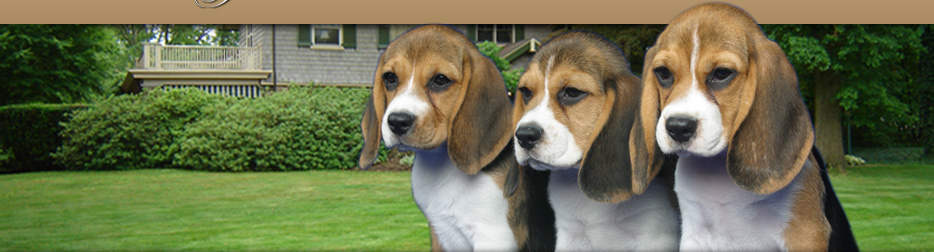
A miniature Foxhound, solid and big for his inches, with the wear-and-tear look of the hound that can last in the chase and follow his quarry to the death.
Color
Any true hound color.
Coat
A close, hard, hound coat of medium length. Defects--A short, thin coat, or of a soft quality.
Varieties
There shall be two varieties:
Thirteen Inch--which shall be for hounds not exceeding 13 inches in height.
Fifteen Inch--which shall be for hounds over 13 but not exceeding 15 inches in height.
Disqualification
Any hound measuring more than 15 inches shall be disqualified.
B - American Kennel Club Breed Standard
Head
The skull should be fairly long, slightly domed at occiput, with cranium broad and full. Ears--Ears set on moderately low, long, reaching when drawn out nearly, if not quite, to the end of the nose; fine in texture, fairly broad-with almost entire absence of erectile power-setting close to the head, with the forward edge slightly inturning to the cheek--rounded at tip. Eyes--Eyes large, set well apart-soft and houndlike--expression gentle and pleading; of a brown or hazel color. Muzzle--Muzzle of medium length-straight and square--cut--the stop moderately defined. Jaws--Level. Lips free from flews; nostrils large and open. Defects--A very flat skull, narrow across the top; excess of dome, eyes small, sharp and terrierlike, or prominent and protruding; muzzle long, snipy or cut away decidedly below the eyes, or very short. Roman-nosed, or upturned, giving a dish-face expression. Ears short, set on high or with a tendency to rise above the point of origin.
Body
Neck and Throat--Neck rising free and light from the shoulders strong in substance yet not loaded, of medium length. The throat clean and free from folds of skin; a slight wrinkle below the angle of the jaw, however, may be allowable. Defects--A thick, short, cloddy neck carried on a line with the top of the shoulders. Throat showing dewlap and folds of skin to a degree termed "throatiness."
Shoulders and Chest
Shoulders sloping--clean, muscular, not heavy or loaded--conveying the idea of freedom of action with activity and strength. Chest deep and broad, but not broad enough to interfere with the free play of the shoulders. Defects--Straight, upright shoulders. Chest disproportionately wide or with lack of depth.
Back, Loin and Ribs
Back short, muscular and strong. Loin broad and slightly arched, and the ribs well sprung, giving abundance of lung room. Defects--Very long or swayed or roached back. Flat, narrow loin. Flat ribs.
Forelegs and Feet
Forelegs--Straight, with plenty of bone in proportion to size of the hound. Pasterns short and straight. Feet--Close, round and firm. Pad full and hard. Defects--Out at elbows. Knees knuckled over forward, or bent backward. Forelegs crooked or Dachshundlike. Feet long, open or spreading.
Hips, Thighs, Hind Legs and Feet
Hips and thighs strong and well muscled, giving abundance of propelling power. Stifles strong and well let down. Hocks firm, symmetrical and moderately bent. Feet close and firm. Defects--Cowhocks, or straight hocks. Lack of muscle and propelling power. Open feet.
Tail
Set moderately high; carried gaily, but not turned forward over the back; with slight curve; short as compared with size of the hound; with brush. Defects--A long tail. Teapot curve or inclined forward from the root. Rat tail with absence of brush.
Coat
A close, hard, hound coat of medium length. Defects--A short, thin coat, or of a soft quality.
Color
Any true hound color. General Appearance
A miniature Foxhound, solid and big for his inches, with the wear-and-tear look of the hound that can last in the chase and follow his quarry to the death. Scale of Points
Head
Skull 5
Ears 10
Eyes 5
Muzzle 5 25
Body
Neck 5
Chest and shoulders 15
Back, loin and ribs 15 35
Running Gear
Forelegs 10
Hips, thighs and hind legs 10
Feet 10 30
Coat 5
Stern 5 10
Total 100
Varieties
There shall be two varieties:
Thirteen Inch--which shall be for hounds not exceeding 13 inches in height.
Fifteen Inch--which shall be for hounds over 13 but not exceeding 15 inches in height.
Disqualification
Any hound measuring more than 15 inches shall be disqualified.
Packs of Beagles
SCORE OF POINTS FOR JUDGING
Hounds
General levelness of pack 40%
Individual merit of hounds 30%
70%
Manners 20%
Appointments 10%
TOTAL 100%
Levelness of Pack
The first thing in a pack to be considered is that they present a unified appearance. The hounds must be as near to the same height, weight, conformation and color as possible.
Individual Merit of the Hounds
Is the individual bench-show quality of the hounds. A very level and sporty pack can be gotten together and not a single hound be a good Beagle. This is to be avoided.
Manners
The hounds must all work gaily and cheerfully, with flags up--obeying all commands cheerfully. They should be broken to heel up, kennel up, follow promptly and stand. Cringing, sulking, lying down to be avoided. Also, a pack must not work as though in terror of master and whips. In Beagle packs it is recommended that the whip be used as little as possible.
Appointments
Master and whips should be dressed alike, the master or huntsman to carry horn--the whips and master to carry light thong whips. One whip should carry extra couplings on shoulder strap.
Recommendations for Show Livery
Black velvet cap, white stock, green coat, white breeches or knickerbockers, green or black stockings, white spats, black or dark brown shoes. Vest and gloves optional. Ladies should turn out exactly the same except for a white skirt instead of white breeches.
Approved September 10, 1957
C - FCI Breed Standard
Kennel Club, London 1994
F.C.I. Standard No. 161
GENERAL APPEARANCE - A sturdy, compactly-built hound, conveying the impression of quality without coarseness.
CHARACTERISTICS - A merry hound whose essential function is to hunt, primarily hare, by following a scent. Bold, with great activity, stamina and determination. Alert, intelligent and of even temperament.
TEMPERAMENT - Amiable and alert, showing no aggression or timidity.
HEAD AND SKULL - Fair length, powerful without being coarse, finer in the bitch, free from frown and wrinkle. Skull slightly domed, moderately wide, with slight peak. Stop well defined and dividing length, between occiput and tip of nose, as equally as possible. Muzzle not snipy, lips reasonably well flewed. Nose broad, preferably black, but less pigmentation permissible in lighter coloured hounds. Nostrils wide.
EYES - Dark brown or hazel, fairly large, not deep set or prominent, set well apart with mild appealing expression.
EARS - Long, with rounded tip, reaching nearly to end of nose when drawn out. Set on low, fine in texture and hanging gracefully close to cheeks.
MOUTH - The jaws should be strong, with a perfect, regular and complete scissor bite, i.e. the upper teeth closely overlapping the lower teeth and set square to the jaws.
NECK - Sufficiently long to enable hound to come down easily to scent, slightly arched and showing little dewlap.
FOREQUARTERS - Shoulders well laid back, not loaded. Forelegs straight and upright well under the hound, good substance, and round in bone, not tapering off to feet. Pasterns short. Elbows firm, turning neither in nor out. Height to elbow about half height at withers.
BODY - Topline straight and level. Chest let down to below elbow. Ribs well sprung and extending well back. Short in the couplings but well balanced. Loins powerful and supple, without excessive tuck-up.
HINDQUARTERS - Muscular thighs. Stifles well bent. Hocks firm, well let down and parallel to each other.
FEET - Tight and firm. Well knuckled up and strongly padded. Not hare-footed. Nails short.
TAIL - Sturdy, moderately long. Set on high, carried gaily but not curled over back or inclined forward from root. Well covered with hair, especially on underside.
GAIT/MOVEMENT - Back level, firm with no indication of roll. Stride free, long reaching in front and straight without high action; hind legs showing drive. Should not move close behind nor paddle nor plait in front. COAT - Short, dense and weatherproof. COLOUR - Any recognised hound colour other than liver. Tip of stern white. SIZE - Desirable minimum height at withers: 33 cm (13 ins). Desirable maximum height at withers: 40 cm (16 ins).
FAULTS - Any departure from the foregoing points should be considered a fault and the seriousness with which the fault should be regarded should be in exact proportion to its degree.
NOTE - Male animals should have two apparently normal testicles fully descended into the scrotum.